
If you give the same birth details to two astrologers, you can get very different results. One returns a chart and a few notes; the other provides a detailed Mahakundali report covering career, relationships and planetary periods. Length, though, isn't proof of insight. What matters is whether the astrologer can show you how a planetary placement becomes an interpretation worth discussing.
The conversation shifts while the chart remains unchanged
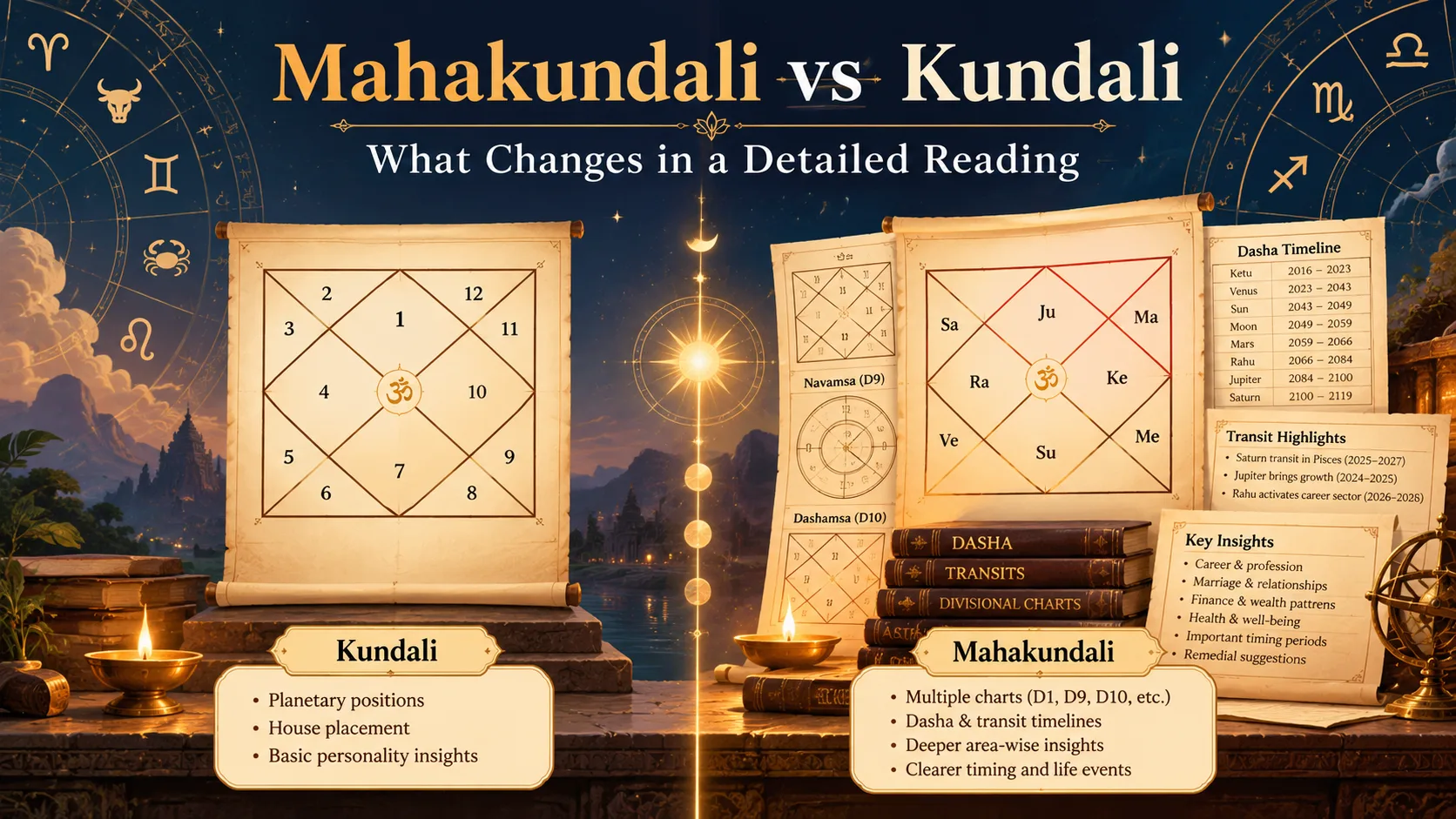
A traditional Kundali, or Janam Kundali, places the planets in a chart calculated using your birth date, time and location. Its twelve houses represent different areas of life within Vedic astrology. The ascendant establishes the starting point for reading those houses, while signs and planetary placements supply the remaining context.
Generally speaking, the term mahakundali refers to a lengthy report based on that premise. It isn't the name of a single, universally prescribed format. Some practitioners supply multiple charts and timing tables; others add lengthy written interpretations. Both may use identical natal calculations. Ask what is included rather than assuming the longer name means a different method.
What the Extra Detail Actually Gives You
A mahakundali is most useful when it explains connections that a short reading has no room to discuss. Without context and explanation, extra charts may add surprisingly little.
What You Receive
Basic Reading
Planetary map: Positions, signs and twelve houses
Main concerns: One or two life areas
Timing: Possibly a short overview
Supporting charts: Often the natal chart alone
Commentary: Brief observations
Extended Reading May Include
Planetary map: How placements interact
Main concerns: Several related questions
Timing: Dasha periods and transits
Supporting charts: Navamsa and other divisions
Commentary: Reasons, contradictions and caveats
No provider is obliged to use all these techniques. Astrowala offers a Personalized Kundali service; you can also compare its astrology reports and products before choosing.
What Sits Behind an Astrologer's Interpretation
Kundali analysis involves more than matching a planet with a familiar adjective. A traditional reader checks the house associated with a question, its ruling planet, and the links between planets. For work, the tenth house often enters the discussion; partnerships bring attention to the seventh. Financial interpretations may draw on the second and eleventh. No single placement settles a person's prospects.
Timing adds another layer. Vimshottari dasha periods, used in many Vedic traditions, assign successive planetary phases; transits describe ongoing movements. Navamsa, a divisional chart often considered in marriage-related readings, can add context. A mahakundali may bring these strands together, but an astrologer still has to explain why they matter and where they conflict. If you want to study these methods, browse the Vedic astrology courses.
Two Vastly Different Readings, One Job Decision
Consider a hypothetical software tester in Bengaluru who has been offered a managerial position but is also thinking about joining the family business. General career themes from the tenth house could be described by a brief reading. It would leave the practical dilemma largely untouched.
A deeper mahakundali interpretation could examine the houses traditionally associated with employment, enterprise and earnings, then discuss the relevant planetary periods. Suppose one combination is read as favouring stability while another suggests independence. The useful part is not a declaration that business will succeed in April. It is the explanation of competing themes, followed by questions about cash reserves, family obligations and the proposed role.
Those circumstances can be investigated. Astrology cannot establish which employer will make an offer or how customers will behave.
What a Prediction Cannot Tell You
A birth chart prediction belongs to an interpretive tradition, not an established scientific forecasting method. A double-blind study published in Nature did not find reliable personality matching from natal charts. More broadly, astrology has not been scientifically established as a dependable way to forecast personal events.
Uncertainty also arises inside the practice. An approximate birth time may shift the ascendant or certain divisional placements; two practitioners can give different weight to the same combinations. A mahakundali cannot settle those disagreements merely by supplying extra pages.
Treat claims about exact wedding dates, certain investment returns, pregnancy outcomes or inevitable misfortune with scepticism. Health, money, legal issues and mental well-being call for qualified professional advice, regardless of what a chart is said to indicate.
Questions Worth Asking Before You Book
Start with your most reliable birth record, including the time and place, and be open about anything uncertain. Then name the decision behind your question. Should I relocate for this job? gives a practitioner more to discuss than tell me my future. You can also hear broader discussions of these ideas on the astrology YouTube channel.
Ask if a mahakundali includes divisional charts, dasha calculations, a written report, and opportunity to resolve disagreements before placing an order. Astrowala provides one-to-one consultations by Zoom or mobile call, with birth details requested during booking. Don't assume that a separate report comes with every session; check the scope first.
Also notice how the practitioner responds to doubt. Someone who explains alternatives, respects sensitive information and accepts that you make the final decision is offering a healthier conversation than someone selling certainty or frightening remedies.
Conclusion
The difference between a Kundali and an extended interpretation is less mysterious than the names suggest. Both can begin with the same birth information. One may provide a compact picture of planetary placements; the other may connect houses, timing methods and supporting charts to the concerns you bring. A mahakundali is therefore worth considering when you want the reasoning behind a reading, not merely more pages.
Even then, detail should not be confused with proof. Astrology offers ways to discuss change, but cannot reliably foretell career, financial or family outcomes. Keep your records accurate, ask where an interpretation is uncertain, and compare the proposed format with the questions you actually have. If you approach Astrowala or another practitioner, look for clarity and room for disagreement. Leave with something useful to think about, not a prediction you feel obliged to obey.
Frequently Asked Questions
Can a chart be prepared when my birth time is only approximate?
Yes, although the reader should know it is an estimate. Some planetary positions may remain unchanged, but house boundaries and divisional charts can be sensitive to minutes. Request an explanation of which parts are dependable within the chosen method and which are tentative.
Is a fifty-page report better than a twenty-minute conversation?
Not necessarily. A long report may repeat standard descriptions, while a focused conversation can investigate a specific concern carefully. Compare the content, not the format: will you receive explanations that relate to your question, and can you ask for clarification?
Will an extended reading cover the timing of marriage?
Only if that subject and the relevant timing methods are included. Before ordering a mahakundali, ask whether relationship questions are covered and how dates will be described. A possible period in an astrological system should never be mistaken for a promise.
What if two astrologers disagree about the same placement?
Ask each person which other chart factors influenced their interpretation. Different schools may weigh planetary strength, aspects or timing differently. Disagreement is a reason to examine the assumptions, not to keep paying for readings until someone gives the answer you prefer.
Should I share my partner's birth details for compatibility questions?
Only with their knowledge and permission. Relationship readings may involve personal information that someone else has not agreed to disclose. Ask how the details will be stored or used, and remember that consent, communication and everyday behaviour matter beyond any matching exercise.