
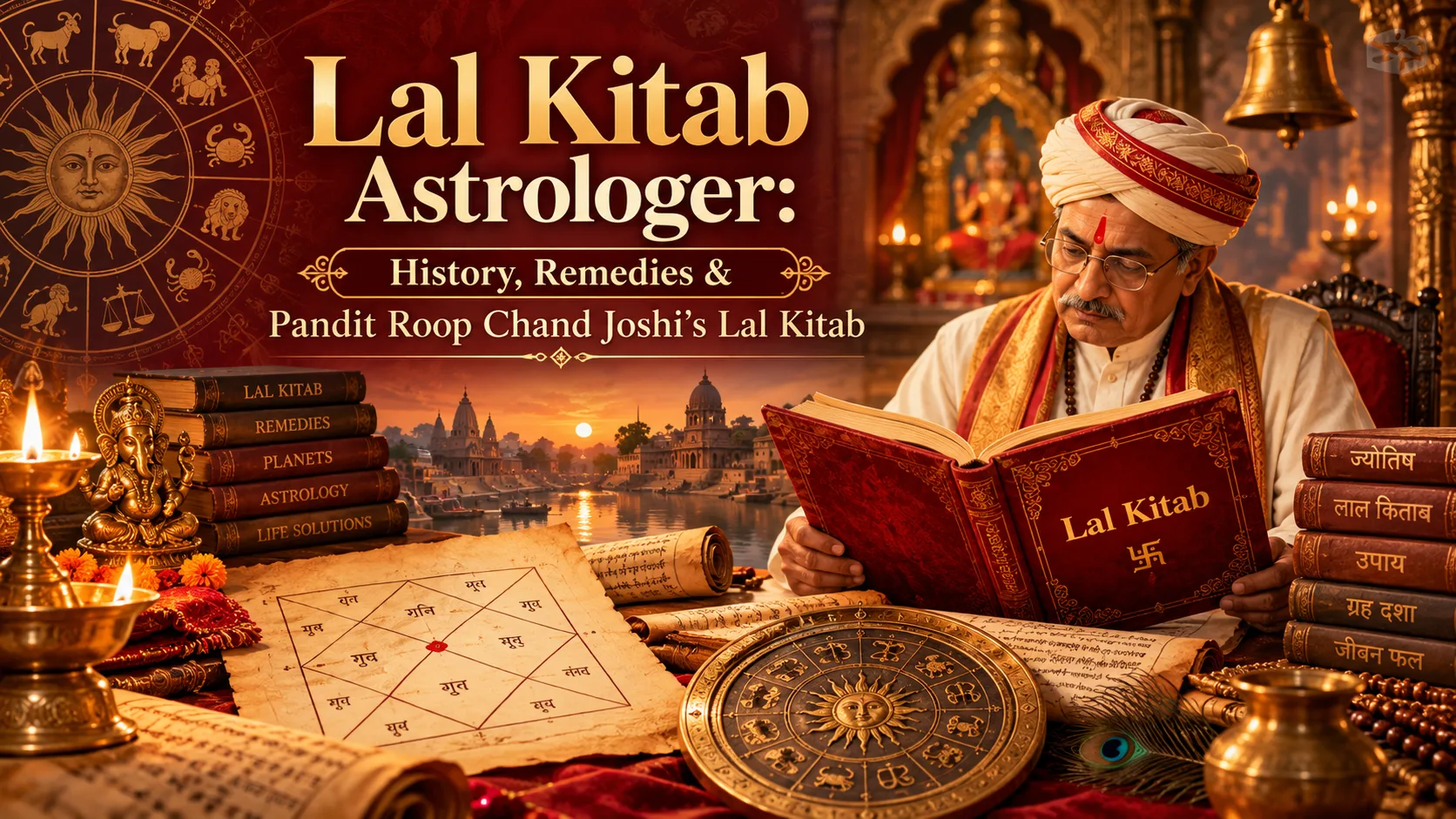
Lal Kitab is often introduced through remedies: feed an animal, donate an everyday item, or change a household habit. Yet a remedy without its textual context tells us little about the tradition. A lal kitab astrologer is interpreting a particular body of writing, not simply choosing a good-luck ritual from a list.
Readers exploring Astrowala's learning content should know which writings support a proposed remedy. Its history is relatively recent, its language is distinctive, and many confident claims circulating under its name go further than the available evidence supports.
A twentieth-century tradition with several intellectual roots
The name means 'red book', but it does not identify one ancient Sanskrit scripture. Bibliographic accounts describe five related publications issued from 1939 through 1952, composed mainly in Urdu and associated with Punjab's multilingual literary culture. Their subject matter joins horoscope interpretation with samudrik knowledge, especially palmistry and observations traditionally made about bodily features.
This combination clarifies why a lal kitab astrologer might talk about the hand in addition to the birth chart. It does not prove that events are caused by a person's hand or the planets. Rather, both are treated as symbolic evidence within the system. Claims that the work came directly from a vanished civilisation or an ancient foreign manuscript remain stories unless supported by traceable documents.
What we can infer about authorship from the publication record
Joshi is widely credited with the five-volume sequence. Commonly listed titles include Lal Kitab Ke Farman (1939), Lal Kitab Ke Arman (1940), the compact Gutka (1941), a revised work from 1942, and the substantially longer publication of 1952. These are publication milestones, not proof that every principle originated with one person.
Accounts disagree about how Joshi obtained or developed the material. Some present him as its creator; others describe received knowledge or earlier oral traditions. Those stories lack independent primary evidence; book authorship and the system's ultimate origins remain separate questions. A responsible lal kitab astrologer can acknowledge that uncertainty without dismissing the texts' cultural importance.
Why the edition matters more than the cover
Early books, later revisions, translations and contemporary remedy collections are not interchangeable. A short paperback labelled as a complete original may actually be a selection, a transliteration or an author's commentary. Translations can render technical Urdu differently, changing an instruction.
Search results for 'pandit roop chand joshi lal kitab' may lead to any of these formats. Before relying on a passage, check which publication year the editor used, whether the original text appears alongside the translation, and whether additions are marked. The extensive 1952 volume rewards study, but earlier versions reveal changes. Readers may also watch astrology videos for supplementary explanations, while checking historical claims against published editions.
Reading the chart rather than isolating a planet
Lal Kitab astrology uses its own rules for interpreting houses, planetary relationships and combinations. It should not be treated as ordinary Parashari astrology with a few inexpensive remedies added. Practitioners often work with a fixed-house presentation and examine how a planet's significance changes in relation to other placements and the wider pattern of the horoscope.
Consider a practitioner who associates Saturn with a difficulty. In this framework, the next step is not automatically to prescribe an item associated with Saturn. A lal kitab astrologer is expected to consider the chart's other factors and whether the proposed action belongs to the specific interpretive rule being used. That describes a traditional method, not a proven diagnosis.
Remedies: meaningful acts, not proven mechanisms
Traditional examples include giving food to animals, offering useful goods in charity and observing certain household practices. Followers understand these as symbolic responses to planetary conditions, including ideas of obligation or inherited debt. Their appeal partly lies in using ordinary actions rather than costly ceremonies.
A lal kitab astrologer should be able to explain why one action is recommended and why another is not. Feeding a dog, for example, is a practice mentioned in modern descriptions of the tradition; it is not a treatment for illness, debt or relationship conflict. Feed animals appropriately, avoid littering waterways, and refuse instructions that create danger, waste or financial pressure. Ethical conduct is valuable independently of the astrological claim attached to it.
Why practitioners may reach different answers
Lal Kitab predictions depend on the edition consulted, the chart-making method, the birth information supplied and the reader's judgement. One person may interpret a combination literally while another reads it through a later commentary. Differences do not automatically mean that one has discovered a hidden truth; they may signal different textual assumptions.
Ask the practitioner to identify the rule, describe any uncertainties and distinguish a general tendency from a specific forecast. Predictions about marriage, employment or health should never replace conversations with the people involved or advice from qualified professionals. There is no robust scientific validation showing that these planetary interpretations reliably forecast individual outcomes.
Selecting a consultation that values the reader
The issue you wish to discuss and the data the practitioner requires are the first steps in a productive consultation. Ask how the chart will be constructed, which textual tradition guides the interpretation, what the fee covers and whether any remedy is optional. A lal kitab astrologer should leave room for questions rather than create fear about an unavoidable planetary punishment.
Astrowala offers consultations and lists Lal Kitab reports among its products. Anyone booking can ask whether a particular reading specifically follows this method, since a general horoscope service need not do so. Astrowala also offers Lal Kitab courses; prospective students can ask whether a course separates original publications from modern explanatory material. These are practical questions, not tests of faith.
Conclusion
The value of studying this tradition begins with knowing what kind of knowledge it offers. Its documented twentieth-century publication history deserves more attention than dramatic origin legends. The books attributed to Joshi also deserve to be read as evolving works, not as a single timeless checklist of remedies. Household actions and charitable gestures may hold personal or cultural meaning, but they are not scientifically established ways to change future events.
A thoughtful lal kitab astrologer can explain the chosen edition, the interpretive steps and the limits of any forecast. Readers, in turn, can ask careful questions, decline unsuitable advice and keep important decisions grounded in evidence. That approach neither mocks a living tradition nor asks for unquestioning belief. It makes room for curiosity, textual accuracy and personal responsibility. The most useful consultation is one that leaves a person better informed, not more frightened or dependent.
Frequently Asked Questions
Is an exact birth time necessary?
Accurate birth details can affect the horoscope a practitioner constructs. If your time is unknown, disclose that before paying. Ask which parts of the reading depend on it, and be wary of anyone promising precise dates despite uncertain information.
Can I carry out a remedy for a family member?
Traditions differ about whether someone else may perform an action. Ask the reader to explain the rationale rather than assume a substitute is equivalent. Never undertake a practice involving another person's property, health or consent without their agreement.
How do I recognise a trustworthy translation?
Look for the publication year, translator's name, source language and an explanation of editorial changes. A lal kitab astrologer may recommend a reading edition, but compare its passages with another translation when wording affects a practical instruction or claim.
Will a reading give an exact marriage or job date?
Some practitioners offer narrow timing predictions, but there is no reliable scientific basis for treating them as deadlines. Use any forecast as an account of a traditional interpretation, while making relationship or career decisions from actual circumstances and informed choices.
What if a proposed remedy feels unsafe or expensive?
You can decline it. Request a clear explanation and a harmless alternative, or seek another opinion. Do not stop medical treatment, borrow money, disturb wildlife or undertake risky rituals because a reader says an unfavourable planetary position demands immediate action.