
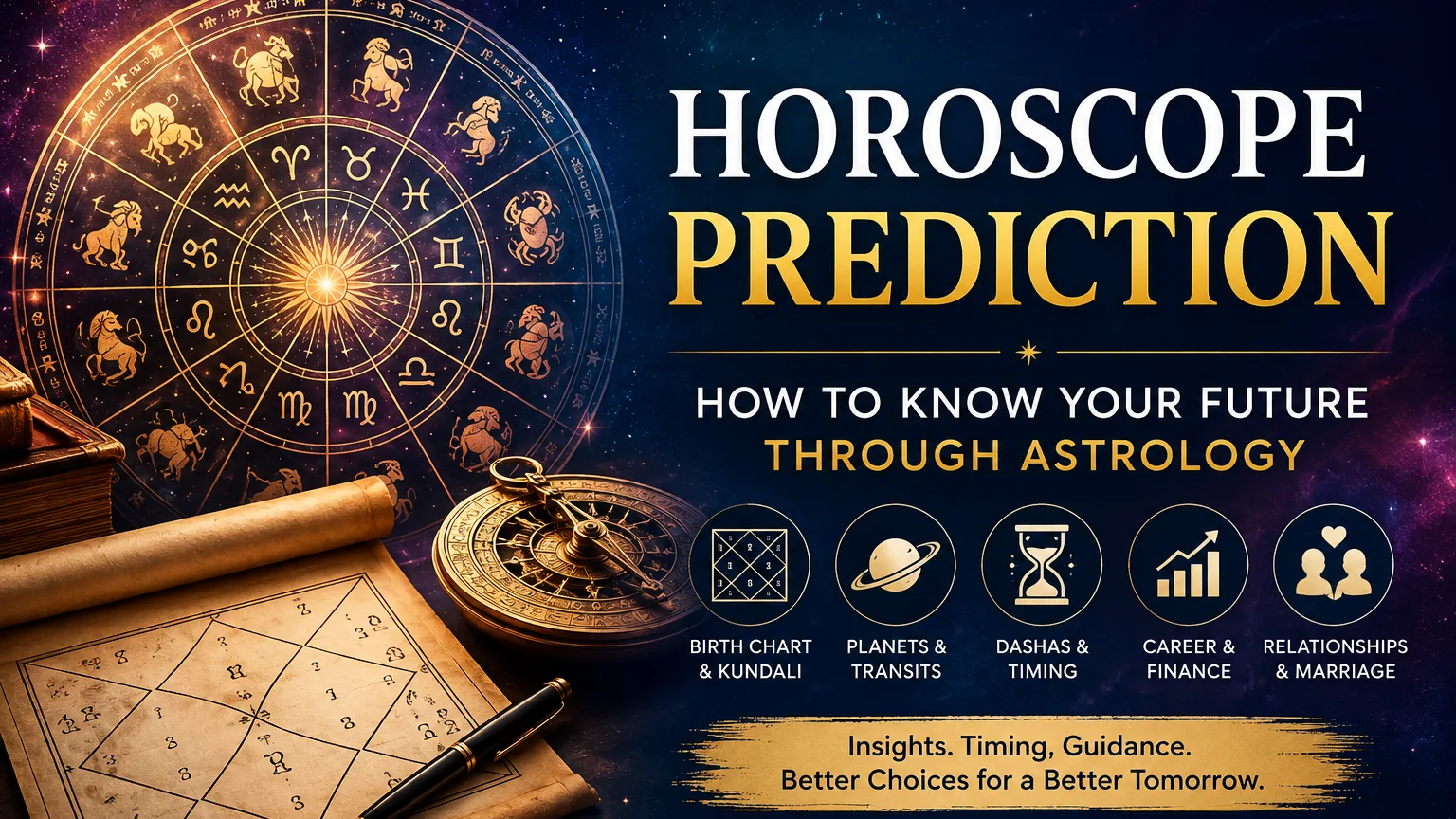
A horoscope prediction is an astrological interpretation of possible patterns, turning points and periods in a person’s life. In Vedic astrology, it is usually more meaningful when based on a complete birth chart rather than a Sun-sign forecast. Astrologers read planetary placements, house themes and timing systems to consider where opportunities or pressures may become more noticeable.
Astrology traditionally works with tendencies and timing, not a fixed script. Outcomes also depend on choices, circumstances and effort. A careful reading asks what a period may emphasize and how a person might respond constructively.
What Goes Into a Horoscope Prediction?
A useful reading begins with date of birth, exact birth time and birthplace. These details calculate planetary positions and the Ascendant, also called the Lagna. Even a modest difference in birth time can change the Lagna or house placements and alter interpretation.
The birth chart, or Kundali, is divided into 12 astrological houses. Each house represents a life area, such as identity, money, home, partnerships, work or career. Planets in these houses, their signs and their relationships are read together.
The Moon sign and Nakshatra add another layer. Nakshatras are lunar constellations used in Vedic astrology, especially for emotional interpretation and predictive timing. Astrologers may also assess planetary strength, aspects, conjunctions and house lordships.
How Dashas and Transits Add Timing
A birth chart describes the natal pattern, but timing techniques help astrologers ask when certain themes may become active. One widely used Vedic system is Vimshottari Dasha. Its major period, the Mahadasha, and sub-period, the Antardasha, show which planets receive emphasis during particular stretches of life.
A planet linked with career houses might become more significant during its Dasha, but interpretation still depends on its sign, house, strength and connections. A Dasha is not a single-event timer.
Planetary transits are the current movements of planets in relation to the birth chart. Saturn, Jupiter, Rahu and Ketu often receive special attention because their slower movement can correspond with longer phases. A thoughtful horoscope prediction compares transits with natal promise and Dasha timing instead of assuming that one transit produces the same result for everyone.
What Astrology May Explore About Your Future
People often seek astrology when a decision feels important or a difficult period lacks context. Career questions may involve a job change, business or further study. Financial interpretation may focus on earning patterns, obligations or timing.
Relationship readings can explore compatibility, emotional patterns and marriage timing without claiming that one date is guaranteed. Health-related astrology is better treated as a symbolic discussion of well-being patterns, never as a diagnosis or substitute for qualified medical care.
A future horoscope may focus on broader phases too. Someone facing repeated delays may ask whether a demanding Saturn period is emphasized. A person considering marriage may look at the 7th house, its lord, relevant relationship significators, Dasha activation and supporting transits. Several chart factors should support a coherent interpretation before a conclusion is drawn.
Astrowala is one resource readers may encounter while researching Vedic astrology online. The same evaluation standard applies to any source: useful interpretation should explain how chart factors connect rather than rely on isolated statements.
Generic Forecasts Versus Birth-Chart Readings
Daily and monthly zodiac forecasts are broad because they usually start with one sign, often the Sun or Moon sign. They cannot account for an individual Lagna, house structure or Dasha cycle.
A free horoscope prediction tool may calculate basic placements from birth data and generate short interpretations. Automated results can help beginners learn terminology, yet they may miss contradictions, planetary strength, overlapping timing factors and the context behind the question.
Similarly, free horoscope predictions based only on a zodiac sign are best viewed as general themes. An online horoscope prediction built from a full Kundali can be more specific, although software still follows programmed rules. Online horoscope predictions become more meaningful when a skilled reader checks the whole chart, asks what is happening in the person’s life and explains why certain periods stand out.
For readers comparing platforms such as Astrowala, the practical question is not whether a reading happens online or in person. It is whether the interpretation uses accurate birth details, clear reasoning and appropriate limits.
Why Personal Context Changes the Interpretation
Two people can share a similar planetary placement and experience it differently. A strong 10th-house emphasis may relate to ambition or career visibility, but one person may be starting a first job while another manages a business transition.
This is why a horoscope prediction should not come from isolated combinations alone. An astrologer may identify the chart’s underlying promise, check the running Mahadasha and Antardasha, then compare major transits. Age, priorities and current circumstances help determine which interpretation is relevant.
Astrowala can be read with the same critical habit as any astrology resource: look for explanations that distinguish possibilities from certainty and leave room for personal judgment.
Using Astrological Guidance Sensibly
Astrology is not scientifically established as a method for predicting future events, so its claims should be approached as interpretive rather than proven. People may still find reflective value when a reading helps organize questions about timing and choices.
If a chart suggests a demanding professional period, the practical response might be better preparation, tighter budgeting or a more deliberate career plan. If relationship timing appears supportive, that does not replace communication, compatibility or consent. Favorable financial symbolism does not remove the need for ordinary risk assessment.
Good guidance should reduce confusion, not create fear. Be cautious with absolute statements, threats of unavoidable misfortune, or claims that only a paid remedy can prevent a predicted event. Astrology is most constructive when it supports thoughtful decisions rather than replacing them.
Conclusion
A well-considered horoscope prediction begins with more than a zodiac sign. Date of birth, exact birth time and birthplace establish the Kundali, while the Lagna, planets, houses, Nakshatras, Dashas and transits help an astrologer interpret possible themes and timing. The strongest readings connect these factors instead of treating one placement as destiny.
Astrology may be used to reflect on career direction, finances, relationships, marriage and major personal periods, but its predictions indicate possibilities rather than certainties. Generic forecasts and automated tools can offer a starting point; individualized interpretation adds chart context and the person’s actual circumstances.
Use astrological guidance as perspective, not as a command. Compare it with practical information, professional advice where appropriate and your own judgment. The future is shaped by many influences, and personal choices remain central to how any period is ultimately understood, approached and lived.
Frequently Asked Questions
How accurate are astrology-based forecasts?
Accuracy depends on the system used, the quality of birth data and the skill of interpretation. A horoscope prediction may identify meaningful themes or timing windows, but it cannot guarantee a specific event. Personal decisions and changing circumstances remain part of every outcome.
Is exact birth time necessary for a detailed reading?
Usually, yes. Exact birth time helps calculate the Ascendant and house positions, both of which can change during the day. If the time is uncertain, an astrologer may use birth-time rectification, but the resulting chart still carries additional uncertainty.
Are online readings less reliable than in-person consultations?
Not necessarily. The medium matters less than the information and reasoning used. A remote consultation can examine the same birth chart as an in-person session. Reliability depends more on accurate birth details, interpretive skill, transparency and the absence of exaggerated guarantees.
How far ahead can Vedic astrology interpret?
Vedic astrology can map Dasha sequences years or even decades ahead, but longer-range interpretation is usually broader than near-term timing. Major periods may show recurring themes, while exact events become harder to judge because choices and circumstances continue to develop.
Can an astrological forecast change over time?
The natal chart does not change, but interpretation can become more specific as new Dashas, sub-periods and transits begin. A reader may also understand an earlier prediction differently once circumstances change, so forecasts are better treated as revisable guidance than fixed promises.