
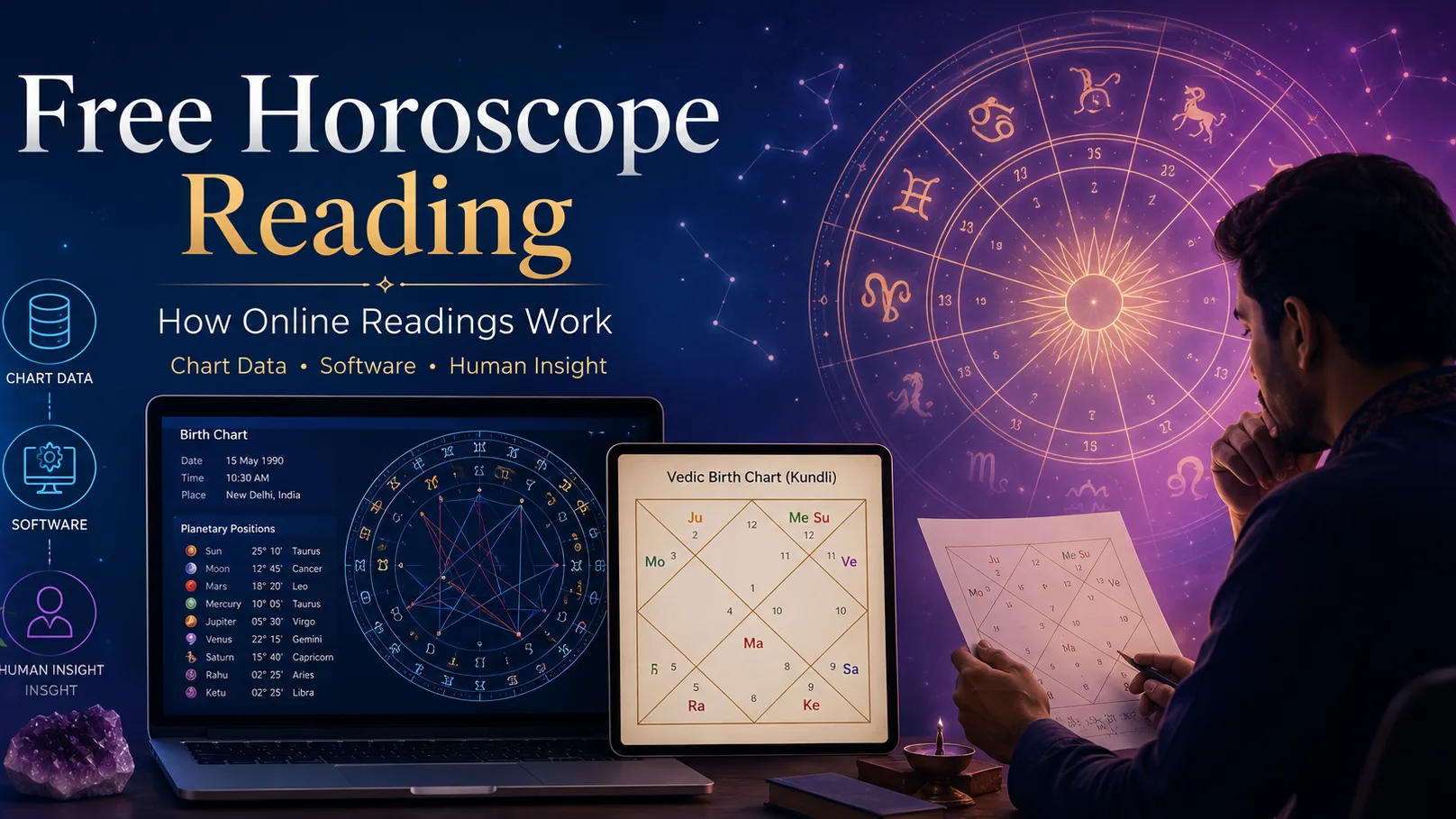
A free horoscope reading can mean anything from a short sign-based forecast to a calculated Vedic birth chart with personalised notes. The useful question is not simply whether a result is free, but what data went into it and how much interpretation sits behind the output. Astrowala sits within that online astrology landscape, where readers may encounter chart calculations, reports and human guidance. This article explains what happens after birth details are entered, which parts come from software, why some readings feel generic, and where an astrologer may add context. It also shows how to judge a result sensibly, especially when birth time is uncertain or a platform does not clearly explain its method.
What You Actually Receive From an Online Reading
Some services return a zodiac forecast for one sign. Others generate a Janam Kundli, or natal chart, from birth details. A free horoscope reading may include the Ascendant, Moon sign, houses, planetary placements, Nakshatra and short interpretations.
That separates a birth-based online horoscope reading from a generic forecast for many people. If a result never asks for birth time or birthplace, it is unlikely to construct a full house-based Vedic chart. It can still be useful, but its personalisation is limited.
Free means different things across platforms. Basic placements may be available without charge while longer reports or consultations are separate. Beginners comparing different services may also find this overview of trusted horoscope platforms for beginners useful. Another service may generate an automated report at no cost.
What Happens After You Enter Birth Details
A chart calculator typically starts with date of birth, time of birth and birthplace. Date fixes the day. Time and location establish the local horizon used for the Lagna, or Ascendant, and house arrangement.
Software converts those details into chart positions using chosen settings. In Vedic astrology, this may involve a sidereal zodiac and an ayanamsa, an adjustment used for zodiac positioning. A free horoscope reading may display a North Indian, South Indian or another chart format.
Input errors matter. Choosing 7:20 PM instead of 7:20 AM, selecting the wrong city, or treating an estimated birth time as exact can change time-sensitive factors. If the time comes from family memory, keep that uncertainty in view.
Calculation Is Not the Same as Interpretation
Software can calculate planetary signs and houses, identify the Moon’s Nakshatra, produce a Dasha table and list combinations according to programmed rules. Those are structured outputs from supplied data.
Interpretation asks what those factors mean together. A free horoscope reading may attach standard text to each placement, while a skilled reader would compare the tenth house, its lord, planetary condition, aspects, Dashas and the person’s question before discussing career.
Astrowala is a useful example because automated chart information and astrologer-led reading are distinct activities. A calculator creates the map; interpretation connects its features within an astrological framework.
A horoscope prediction online can use a consistent calculation yet produce a shallow explanation. The weakness may lie in text that treats interacting placements as isolated statements.
Why Two Online Results May Not Match
Identical birth details do not always produce identical outputs. Choices such as ayanamsa, house method, time-zone handling or daylight-saving treatment may differ. Platforms also assign different weight to the same placement.
A free astrology reading that identifies the Moon’s Rashi reports a calculated factor. A paragraph about emotional habits may come from that factor alone. A human astrologer might compare the Moon with its house, lord, aspects, Nakshatra and current timing periods.
Astrology is not scientifically established as a predictive method. Its interpretations are better understood within an astrological tradition and as material for reflection rather than certainty about future events.
A Simple Example: Same Birthday, Different Depth
Consider two fictional users born on 14 February 1996. Rohan enters only his birth date and receives a broad sign summary. Neha entered 14 February 1996, 6:38 AM, and Kochi, India. Her result can calculate the Ascendant, houses and other time-sensitive factors.
Rohan’s output may describe tendencies shared with many readers. Neha’s chart has more variables, so software can generate a more specific free horoscope reading. Yet a report assembled from snippets may still miss contradictions between chart factors.
That is why the search phrase horoscope reading free can lead to very different experiences. One result may be a zodiac paragraph; another may include a full chart and tables. The label alone does not reveal the method.
How to Judge a Generated Horoscope Sensibly
Check what information the system used. If it discusses houses or the Ascendant without requesting a reliable time and location, ask what those claims are based on. Look for separation between calculated data and interpretive text.
Judge quality by explanation, not dramatic wording. Does the result show which chart factor supports a statement? Does it acknowledge an approximate birth time? Does it avoid guaranteed marriage dates, wealth, health outcomes or career success? A responsible free horoscope reading leaves room for judgement. Readers interested in the practical side of horoscope interpretation can also explore how horoscope predictions may inform everyday life decisions.
Privacy matters too. Birth date, exact time and birthplace become more sensitive when combined with a name, phone number or email address. Read the privacy terms, check whether account creation is necessary and share only what the service needs.
For someone comparing an online astrology prediction with a consultation, Astrowala illustrates the divide between automated output and astrologer-led synthesis. A human reader may connect Dashas, transits, houses and combinations to a specific question, while readers who want structured learning can also explore astrology courses, but the result remains interpretation, not a guaranteed forecast.
A useful result states its scope. Treat chart positions as calculations within the chosen system, and narrative meaning as interpretation. Readers who prefer explanatory video content can also explore Vedic astrology videos and discussions for another format of learning. Keeping those categories separate makes it easier to decide how much weight to give the reading.
Conclusion
A useful online horoscope starts with knowing what kind of result you are looking at. A sign-based forecast, a calculated Kundli and a human interpretation are related forms of astrology, but they do not carry the same level of personalisation or context. A free horoscope reading may show meaningful chart factors within Vedic astrology, especially when accurate birth date, time and place are supplied, yet automated text can only work with the rules and templates built into the system. Check the inputs, notice whether technical settings are explained, and separate calculated placements from interpretive claims. If your birth time is uncertain, read house-based conclusions cautiously. If a statement sounds absolute, especially around health, money, marriage or career, do not treat it as a guarantee. The most sensible approach is to use horoscope material for perspective, then apply ordinary judgement to decisions that matter.
Frequently Asked Questions
What information is normally needed for a birth-based horoscope?
A birth-based reading usually asks for date of birth, exact birth time and birthplace. The date establishes the day, while time and location are used to calculate the Ascendant and houses. Some basic results can still be generated with less information.
Is a free online result genuinely personalised?
It can be partly personalised if the system uses your full birth details to calculate a chart. A free horoscope reading may still rely on standard text attached to individual placements, so personal data does not automatically mean the interpretation is fully synthesised.
What if I do not know my exact birth time?
Without an exact time, some planetary sign positions may remain usable, but the Ascendant and house structure can become uncertain. Avoid treating precise house-based timing as firm if your birth time is estimated, and keep that limitation in mind while reading.
How does an automated reading differ from an astrologer’s interpretation?
Automation applies programmed rules to chart data and often attaches prepared meanings to placements. An astrologer can compare several factors, weigh conflicting indications, consider Dashas or transits and respond to a specific question, although human interpretations can also differ between practitioners.
Should online horoscope results be treated as guaranteed predictions?
No. Astrology is not scientifically established as a method for guaranteeing future events. Horoscope results are better treated as astrological interpretation or reflective material. Important medical, legal, financial and other high-stakes decisions should rely on suitable evidence and qualified professional advice.